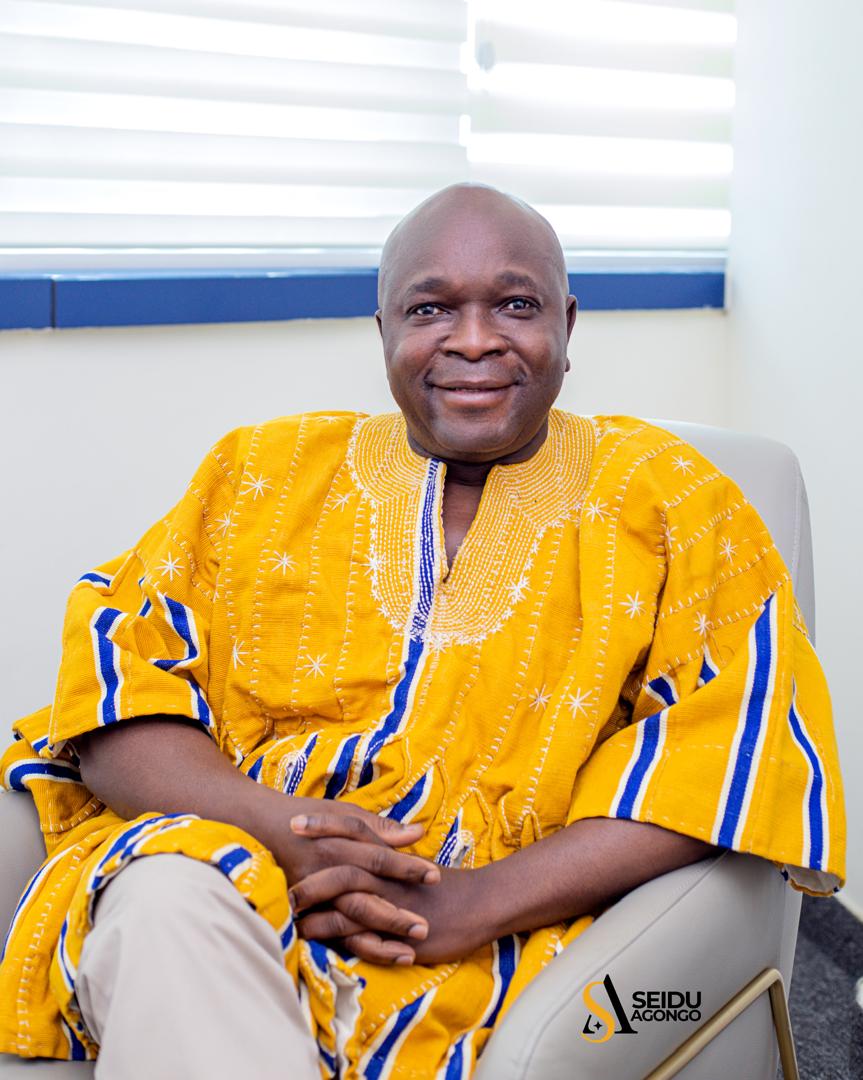
By Alhaji Seidu Agongo
For those of us from the heartland of the smock, our earliest memory of the revered fugu goes back to our grandfathers and fathers.
I must have been no more than six or seven years old when I watched my late dad pull on his heavy, beautifully woven garment before always stepping out for important community gatherings, funerals or festivals.
He was often joined by siblings and neighbors, creating a unique chorus of heavy weights who moved in sync, not saying much, but allowing the fabric to speak for them.
Those beautiful smocks, sometimes worn with matching hats and trousers, carried the weight of their authority, pride of our heritage, and the quiet dignity of men and a people rooted in something larger than them.
As children, the smock symbolized identity, power, history and who we are.
Now as an adult and with my own choices of attire, I perfectly understand why my grandfathers, dad and their siblings reserved the smock for such unique occasions.
The Mahama blouse
So when President John Dramani Mahama stepped onto Zambian soil last two weeks, wearing the same proud northern attire, I immediately understood what he intended to project: a symbol of Ghanaian heritage displayed on foreign soil with confidence and dignity.
But Zambia’s social media crowd did not understand it. A few even mistook it for a blouse, sparking the now famous “fugu debate” that has turned out to be one of the biggest marketing tools for a historic dress.
For us, what they saw as unfamiliar fashion, we know it to be centuries-old emblem of royalty, warrior strength, craftsmanship, and cultural memory.
Instead of reacting with anger, Ghanaians, in our unique way rallied in a way that cut across politics, tribe, class and age. The misunderstanding online ignited a cultural wave at home, leading to nationwide celebrations such as the free fugu photoshoot at the Independence Square, the rep your fugu Friday, and the subsequent declaration of every Wednesday as fugu day by the Ministry of Tourism and Creative Arts, as citizens proudly donned their smocks to educate, defend and promote our heritage.
This was unity in its purest form, not orchestrated by our usual politics, but by woven by cultural instinct and harnessed through modern social media.
This reminded me of my childhood lesson: when you carry your identity with confidence, the world eventually takes notice.
Mockery to busines
The beauty of this episode is that unity did not stop at symbolism. It translated into tangible economic opportunities.
President Mahama himself noted that the episode gave Ghanaian weavers “branding and marketing they couldn’t have dreamed of,” pointing to the surge in global searches for fugu, batakari and smock.
Zambia’s Revenue Authority has even issued exemptions for fugu’s imports, easing charges for business people wishing to leveraging the opportunity to sell the colourful fugu to Zambians and the entire East African community.
Indeed, Zambia’s President Hichilema has expressed interest in importing fugus. Thus, in the space of days, Ghana’s cultural attire became a global export conversation, clear evidence of what happens when a nation moves as one.
Our real enemy is them, not us
For those looking beyond the marketing and business opportunities, the fugu fight revealed something bigger. As Ghanaians, we will argue tirelessly among themselves on politics, governance, policy and ideology and that is normal, if not necessary.
But when our collective identity is challenged, we stand as one people with one voice.
It reminded me and all of us that our real adversaries are not our political opponents or fellow citizens who disagree with us. Our true enemies are the poverty that still holds too many of our people back, the diseases that weaken our communities, the ethnic, political, and generational divisions that reduce our national potential, and the external or internal narratives that mock or undermine our collective dignity.
The Zambia fugu moment showed that when we unite, even briefly, we create social energy that is powerful enough to shape global conversations, unlock business opportunities, and strengthen our national brand.
Now imagine what we can achieve with all that?
If unity around a single garment can deliver all the unmatched sales, visibility, national pride and global recognition, imagine the impact of uniting around our precious cocoa sector, industrialisation, agriculture, education, youth employment, or public health.
Imagine us uniting against illegal mining, in a way that sees it as a catalyst for development, where districts are empowered with the right expertise to properly supervise groups to mine responsibly.
Indeed, unity is a national economic strategy, far beyond a slogan.
Thus, when I think back to my father’s smock and how it made him larger than life in my young eyes, I realise that same aura wrapped itself around President Mahama during his Zambia visit.
The world simply needed time to understand it. Thanks to the united power of Ghanaians, especially those on social media, the world quickly saw and embraced it.
Now, the bigger lesson here like the threads of the fugu, individually thin but collectively unbreakable, so too is the power of the Ghanaian people when we weave ourselves together in purpose for whatever task we take on.
The writer is a businessman and philanthropist